REGARDING: THE SECRET BOOK OF ARTEPHIUS
The Secret Book of Artephius stands as one of the most famous medieval texts on the philosopher’s stone. Its authorship is attributed to a shadowy figure known as Artephius, said to have lived in the twelfth century and described in later traditions as a Moorish or Arab adept. The book survives in Latin and in numerous translations and paraphrases. The version most widely read in the modern era comes from Lapidus’ In Pursuit of Gold (London, 1976), which reprints the full English translation.
Artephius himself is a puzzle. The text attributes to him a lifespan of more than a thousand years, supposedly prolonged by use of the Stone’s elixir. Such claims are legendary, intended to authorize the text with superhuman antiquity. It is far more likely that the name Artephius is a pseudonym, a mask for a compiler drawing from earlier authorities. Nonetheless, the book has been cited for centuries—by Roger Bacon, George Ripley, Eirenaeus Philalethes, and many others—as one of the clearest revelations of the process.
The Secret Book is presented as a revelation of the entire operation leading to the Stone. Artephius insists that although previous philosophers wrote in riddles, he has chosen to speak plainly and generously. He claims to reveal all that is needed, with only one hidden detail reserved as the true “secret of secrets.” Whether he succeeds in clarity is another matter, for the text is laden with repetitions, allegories, and overlapping synonyms. Yet beneath this verbal fog, there are consistent outlines of an operative sequence that can be decoded.
At its heart, the book emphasizes three linked ideas: the secret fire, the philosophical mercury, and the stone itself. The secret fire is described as an invisible principle, at once vinegar, Azoth, moist fire, and living water. It is not a literal flame, but a solvent and catalyst that works “gently, with great ingenuity.” The philosophical mercury is said to be drawn from antimony, mercury, and gold, a living water in which bodies are dissolved, killed, and reborn. And finally, the stone is the perfected product, formed by putrefaction, whitening, and reddening within a sealed vessel under a continuous and moderate fire.
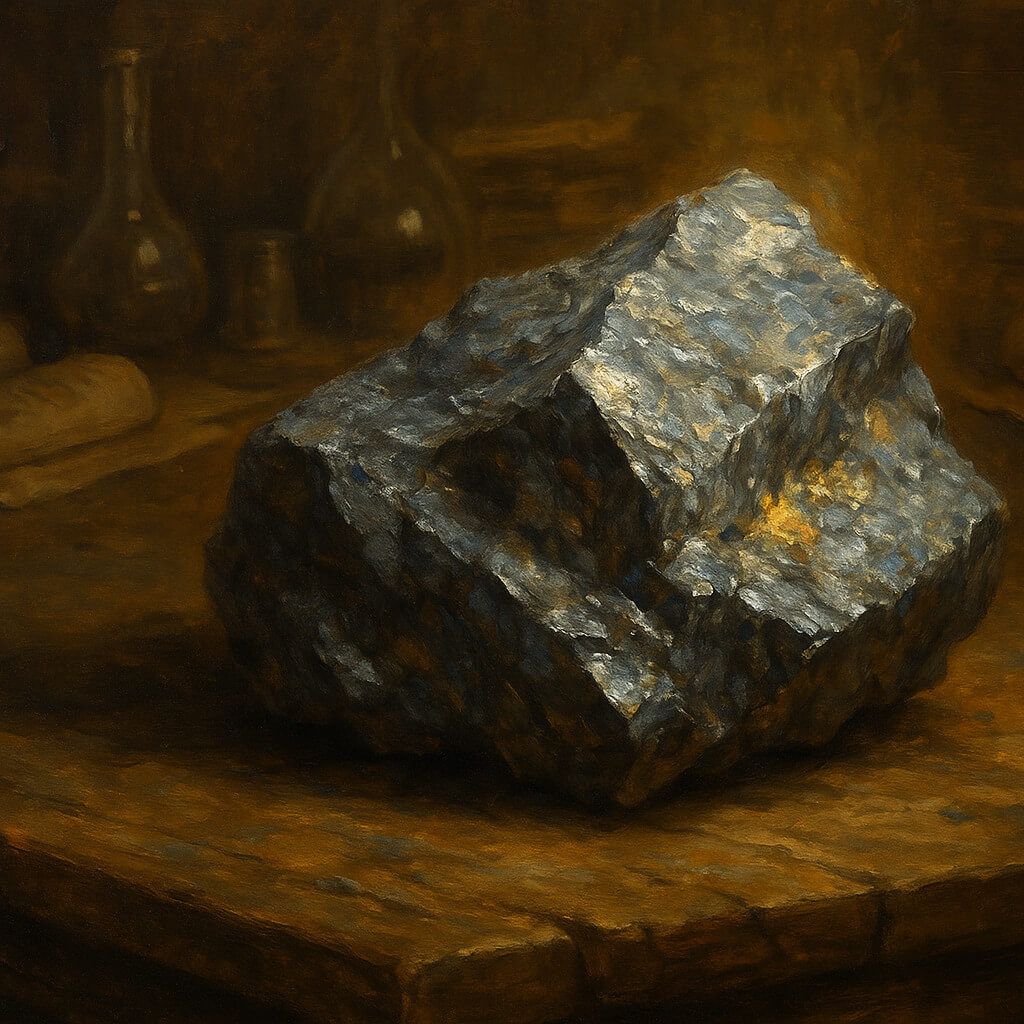
Throughout the treatise, Artephius returns again and again to antimony as the privileged matter of the work. He writes that antimony contains within it a hidden argent vive, a mercury of the philosophers, and that gold alone is swallowed up by this mercurial spirit. He stresses that without this antimonial mercury, no metal can be truly whitened or brought back to its first matter. This doctrine marks the book as part of what later became the “antimonial school” of European alchemy, where antimony was treated not only as a medicine in its own right but as the mineral key to the transmutation of metals.
Alongside antimony, Artephius emphasizes the role of a special water. This is no common water but a philosophical menstruum, described with an extraordinary pile of names: oil, vinegar, virgin’s milk, the balneum Mariae, the fountain, the moist fire, the hidden flame. All these terms serve to veil what is essentially the operative solvent. Its role is to dissolve metallic bodies back to their primordial softness, a process Artephius calls “reincrudation”—the return of metals to their crude, first matter.
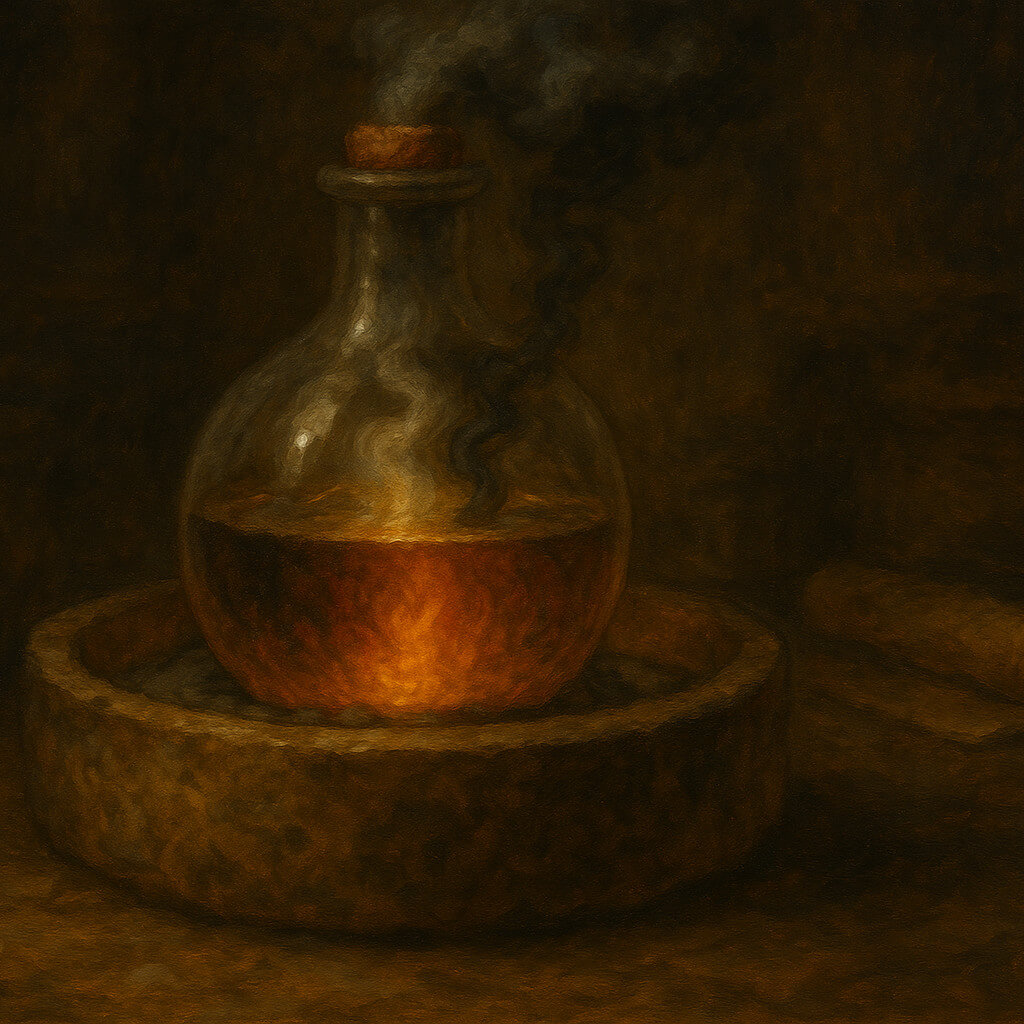
The actual process, as Artephius frames it, is deceptively simple. All is to be done in one vessel, with one matter, one fire, and one operation. The gold and silver, once joined with the antimonial mercury and the living water, are to be sealed in a glass vessel. This vessel is placed upon a gentle and continuous heat, often compared to the warmth of a hen brooding her eggs. The work then unfolds through the familiar stages of blackening, whitening, and reddening.
At first, a profound blackness appears, the sign of putrefaction and death. After long digestion, the black yields to whiteness, a sign of purification. With further work, the matter becomes citrine and finally red. The red stage signals perfection: the Stone is born, a fixed and incombustible substance capable of transmuting metals and extending life. Artephius insists that the colors are true, literal signs of the matter’s transformation, not merely allegorical images.
He also notes certain practical markers that reveal laboratory familiarity: the feces that must be discarded from the bottom of the vessel, the foul stench produced during putrefaction, the risk of burning the matter if the fire is too strong. Such details suggest a writer who knew the difficulties of handling volatile minerals and sealed vessels, rather than a mere compiler of symbolic lore
.
Yet for all these apparent clarities, Artephius envelops his instructions in a cloud of allegory. The solvent is not named plainly but hidden under a dozen titles. The fire is not fire but a “moist fire.” Gold is sometimes Sol, sometimes the king, sometimes the body. Silver is Luna, the queen, the bride. The philosophical mercury is at once Azoth, vinegar, water, milk, oil, and fire. This multiplication of synonyms, while confusing, was intentional: a means of preserving secrecy while still appearing generous.
The text also suffers from repetition. Artephius continually insists that the whole art is nothing more than “one stone, one vessel, one fire, one operation.” He repeats this refrain almost obsessively, perhaps to simplify the reader’s conception, perhaps to discourage the proliferation of false recipes. But the effect is paradoxical: the more he insists on simplicity, the more his layered synonyms complicate it.
The crucial question is whether Artephius himself truly possessed the Stone, or whether he was simply repeating older doctrines with the authority of a pseudonym. On the one hand, the text does exhibit signs of real laboratory engagement: awareness of apparatus, of the hazards of vapors, of the difficulty of maintaining moderate heat, of the sensory markers of success and failure. These are not the details one expects from a pure armchair philosopher.
On the other hand, Artephius’ claims of superhuman longevity and of speaking more plainly than all who came before are marks of rhetorical inflation. His repeated declarations that the work is simple, combined with his refusal to name substances openly, suggest a compiler’s strategy rather than the confident testimony of a master. His dependence on antimony echoes earlier Arabic and Geberian chemistry, while his allegories are familiar from the hermetic tradition.
The most balanced verdict is that Artephius was a compiler with partial laboratory experience. He probably conducted experiments with antimony, sublimation, and dissolution, but the grand Stone narrative he presents is a synthesis drawn from multiple sources, elevated into a total vision.
Whatever Artephius’ personal competence, the Secret Book was profoundly influential. It gave European readers one of the first sustained narratives of the Stone as a real, attainable product. It spread the antimonial path, convincing generations of adepts that antimony held the secret mercury. It reinforced the doctrine that the whole work is one in essence: one vessel, one fire, one matter. And it articulated the sequence of color changes as the infallible signs of success.
For later alchemists, Artephius became a standard authority, cited as if he were an ancient sage. His emphasis on the unity of the work echoed in the writings of Ripley and Philalethes. His insistence on antimony became a dominant theme through Basil Valentine and into early modern Europe. Even his extravagant claim to a thousand years of life was repeated, a testimony to the allure of the philosopher’s elixir as a medicine of longevity.
For our larger project, Artephius marks the point where the symbolic heritage of the Emerald Tablet and the practical observations of Zosimos converge into a medieval Stone doctrine. From the Tablet he inherits the insistence on one mediating subject; from Zosimos the pattern of circulation, putrefaction, and rebirth; and from Arabic chemistry the emphasis on mercury and antimony.
His book teaches us that the Stone, as conceived by the twelfth century, was not a nebulous idea but a concrete goal with defined matter, vessel, fire, and stages. The simplicity he boasts of is deceptive, but the fact that he stresses it at all shows that by his day, the multiplicity of recipes had already become a source of confusion. Artephius’ solution was to insist that all true paths reduce to one.
The Secret Book of Artephius is not the naked truth it claims to be. It is a woven fabric of allegory, compilation, partial laboratory experience, and rhetorical display. But it is also a landmark: the first text in Latin Christendom to present a full and coherent sequence for the creation of the Stone. It became a cornerstone for centuries of speculation and practice.
For us, Artephius represents the bridge between early visionary and chemical traditions and the later mature Stone literature. He embodies both the authority and the uncertainty of the art: the authority to speak of a real, physical Stone, and the uncertainty that leaves us forever sifting allegory from practice.