REGARDING: The Emerald Tablet and Zosimos of Panopolis
Regarding:
The Emerald Tablet and Zosimos of Panopolis
The First Books.
If the philosopher’s stone is our focal point—especially as it relates to spagyric medicine—then two prefaces are indispensable. First, the Emerald Tablet, the tiny text that became the symbolic charter for “as above, so below,” the canonical image of mediation between the heavens and the earth through a singular “One Thing.” Second, Zosimos of Panopolis, the earliest voice in which we can hear the furnace door open and the hiss of vapors, even as a mystic drama unfolds in visions. One gives the idiom; the other gives the craft. Neither gives a recipe for the medieval or early modern “Stone” as such, but together they sketch the intellectual and operative horizon within which the Stone later becomes imaginable as an object with both metallic and medicinal virtues.
Beginning here has a further advantage. Much of the later Stone literature alternates between two registers: a cosmological rhetoric that sounds as if nothing can be done without cosmic sympathy, and lab notes that sound as if everything depends on patient work with glass and fire. The Tablet and Zosimos show that this double register is not a later confusion; it is foundational. The art is born with a split tongue: half liturgy, half workshop.
The Emerald Tablet: A Program Without a Procedure
The Tabula Smaragdina is not a manual, and it was never intended to be one. It states a metaphysical program in the compressed grammar of aphorism. The themes are recognizable: the analogical consonance of macrocosm and microcosm (“as above, so below” in the popular Latin), the cyclical motion of descent and ascent, the separation of subtle from gross “with great ingenuity,” and the claim that this operation unveils the “glory of the whole world.” At the center stands a “One Thing”—variously glossed in later commentaries as a universal spirit, a mercurial radical moisture, the anima mundi, or simply the subject of the work.
Three observations are decisive for our purposes.
First, the Tablet offers no apparatus. There are no furnaces, no vessels, no reagents named in a way that would let an operator begin. This is not a failure; it is genre. The Tablet is a charter myth that anoints a certain way of looking: the world is readable because it is threaded by a single mediating principle, and the operative art is the disciplined separation and reconciliation of contraries in that principle.
Second, the Tablet prizes method without method. “Separate the subtle from the gross… gently and with great ingenuity.” That sentence has been a vast magnet for projection. Every later school reads its own preferred method into the phrase: repeated distillations, philosophical sublimations, circulations, extractions, even purely contemplative “separations” of attention. The Tablet itself is indifferent. It names a structure, not a sequence.
Third, the Tablet is retrofit-friendly. Because it specifies no operations, it accommodates any number of them after the fact. Medieval and Renaissance authors use it as a signature beneath their own procedures, not as a source of those procedures. This makes the Tablet potent as a rhetorical warrant and weak as a forensic witness. It cannot testify to what was done; it testifies only to what was thought fitting as a frame.
What does this mean for a project focused on the Stone? The Tablet does not tell us how to make it. It tells us why the Stone could be conceived as a single, perfected “subject” that mediates heaven and earth and therefore could, in theory, tincture metals and bodies. The Tablet is cosmological permission, not operational instruction.
Zosimos of Panopolis: The Vision in the Workshop
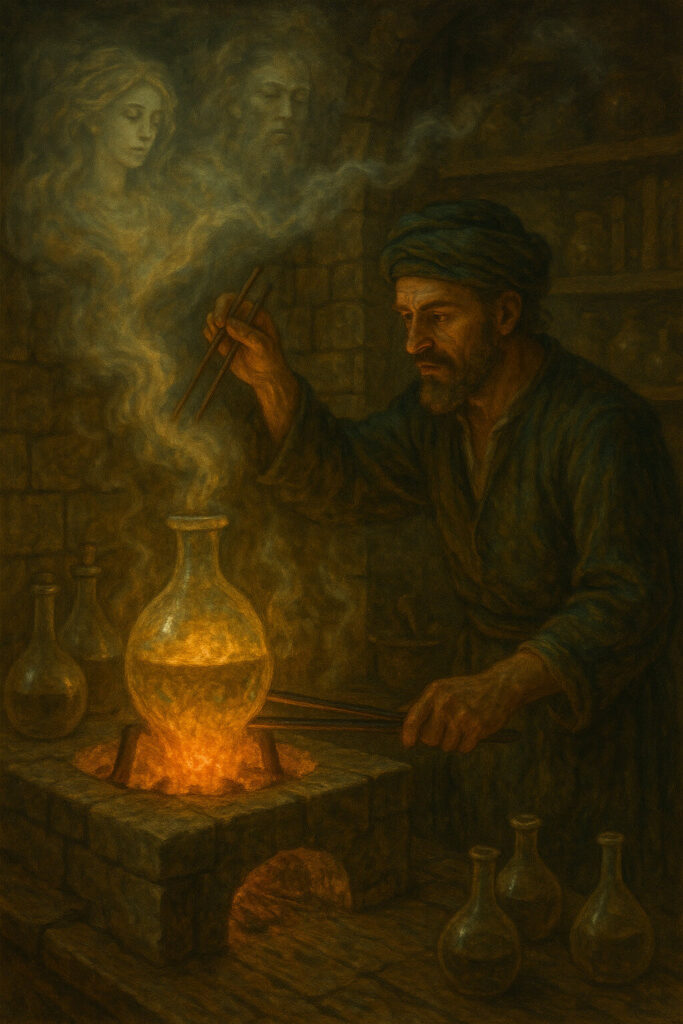
Zosimos lives a millennium earlier than the Tablet’s Arabic witnesses, yet he is closer to us in one crucial sense: his work smells of the shop. He writes of furnaces and bathes, of the kerotakis (a sealed apparatus that recirculates vapors), of distillations, sublimations, fixations, calcinations, and slow, even heatings. He names copper, mercury, sulfur, vitriols, and “divine waters.” He warns of suffocating vapors. He describes failure modes. He sees, touches, and coughs.
Then, suddenly, he dreams. Priests dismember themselves and are consumed in a vessel; metals die and are reborn; a “man of bronze” instructs him. The language turns liturgical and soteriological: purification by fire, baptismal washings, redemption through dissolution and coction. To modern readers, the alternation can feel jarring. To Zosimos, it is seamless. The ritual drama and the laboratory process are the same event at different registers of the soul.
Two features of Zosimos matter most for a Stone-oriented history.
1) Apparatus as theology. The kerotakis is not merely a piece of glassware; it is a cosmogram. To seal a subject, to bring about its gentle dissolution by a regulated, moist heat, to raise its subtile parts and condense them so that “what is above returns to what is below”—this is an early, literal instantiation of the Tablet’s logic, already centuries before the Tablet is framed. Zosimos’s technical imagination gives tangible form to the doctrine of circulation, separation, and reunion.
2) Tincture without a Stone. Zosimos speaks of a divine or “authentic” tincture and of whitening and reddening. He can imagine a substance that, once perfected, imparts its form to other bodies. Yet he does not write of a philosopher’s stone in the medieval sense: a fixed stone-like ferment that, in vanishingly small quantities, permanently multiplies metal or medicinal virtues without loss of its own power. Zosimos’s horizon is tinctural and sacramental, not “Stone” as a capitalized object with all the later attributions. This distinction warns us against a common anachronism: reading the mature medieval Stone backwards into the late antique texts.
If the Tablet supplies the idea of a mediating “One Thing,” Zosimos supplies the first credible record of the bench procedures by which such a thing might be coaxed into manifest utility. His voice does not yet narrate the Stone, but it does narrate the kind of work that makes the Stone thinkable.
The Two Registers: Allegory and Operation
From the start, alchemy speaks with two voices at once. The Tablet embodies the metaphysical; Zosimos embodies the operative; both overlay one another. Later tradition will preserve that braid: the spiritual allegory that insists the operator undergo the same purifications as the matter, and the obsessive practical detail that insists no allegory can substitute for patient control of fire, vessel, and time. This duality will produce, over centuries, two temptations:
-
The allegorical inflation: everything becomes symbol; operations are subordinate rhetoric. Books swell with shimmering correspondences and offer no constraints for the bench.
-
The reductive procedure: everything becomes recipe; the cosmology is decorative. Books insist upon temperatures and timings as if the world were a machine—yet without a metaphysical narrative to explain why the “One Thing” is privileged and why any of this should produce universal effects.
The best authors refuse both temptations. They join Zosimos in giving us enough of the fire and glass to demonstrate experience, and enough of the myth to bind the work to a vision of the world in which transmutation and medicinal virtue are coherent. Read this way, the Tablet and Zosimos are not opposites; they are mutual correctives.
Toward Spagyric Medicine
If our project aims to track how Stone-lore interfaces with spagyric medicine, we must mark a path. “Spagyric” in Paracelsian language signifies separation and recombination—spao (to separate), ageiro (to reunite). The conceptual seed is already present: the Tablet’s separation of subtle from gross, Zosimos’s washings and coctions, the fixation of volatile and volatilization of fixed. What changes in the early modern period is scope and end: metallurgical transformations that once lent authority become supporting analogies for a medicine in which the separated virtues of a plant or mineral are recombined to produce an exalted, often sulfur–mercury–salt triadic medicine. The Stone, under this spagyric reading, becomes either:
-
A metallurgical ferment whose universality is rhetorically extended to the human body (the “medicinal Stone”), or
-
A directly medicinal ferment prepared by spagyric separation and recombination (the “vegetable Stone,” philosophers’ Stone by analogy).
The Tablet’s program and Zosimos’s practice anticipate this move. They authorize the operator to see one logic in the cosmos and the lab, to perform one separation and one reunion across substrates, and to expect one perfection to appear wherever the “One Thing” is rightly treated. This is how a metallurgical artifact becomes a medicine without changing its metaphysical spine.
What the Later Stone Literature Inherits
When medieval and Renaissance authors begin speaking of a “Stone” with consistency, they are inheriting at least five strands traceable to our two precursors:
-
Unity of subject: The insistence that the work proceeds on a single “thing,” however named, is the Tablet’s bequest.
-
Circulation and gentle regimen: The expectation that heat, moisture, sealing, and repeated recirculation produce separation of subtle and gross is Zosimos’s bequest.
-
Color stages: Whitening and reddening as markers of perfection appear already in Zosimos, not as a medieval invention.
-
Tinctural logic: The idea that a perfected matter conveys its form without loss—tincture—belongs to late antique and Arabic practice; the Stone systematizes and absolutizes it.
-
Moral isomorphism: The belief that the operator’s purification mirrors the matter’s purification is native to Zosimos’s visionary mode; the Tablet’s cosmology sanctions it.
To read later authors well, we must hold these five strands at once. When an author writes of “the One Thing,” do they mean a universal spirit descended from the Tablet’s metaphysics, or a specific metallic subject in Zosimos’s line? When they speak of “circulation,” do they suppose a symbolic ascent and descent or an operation in a sealed apparatus? When they insist upon whitening and reddening, is that a narrative of spiritual stages or an observed set of color changes tied to the capture and fixation of volatile principles? The strongest books will tie all three questions back to the bench.
Text-Critical Cautions That Already Matter
Beginning with the Tablet and Zosimos invites two textual cautions that will recur throughout this series.
A. Retrofit reading
Later authors often quote the Tablet as if it were the source of their operations. Historically, it is a license and a rhetorical seal, not a source. We will continually ask whether the Tablet is being used to legitimate a procedure already known, or to instruct one. The difference matters: the first can be honest; the second can be wishful.
B. Anachronistic Stone
Zosimos’s tincture and color cycles are not yet the medieval “Stone.” When an early author uses language that resembles later Stone lore, we will test whether they mean a fixed, catalytic ferment with indefinite multiplication, or a sacramental reagent used in a finite way. The two are not interchangeable. Treating them as if they were is a classic source of confusion.
These cautions are not pedantry; they are instruments of judgment. Our guiding task—distinguishing practitioners from compilers—depends on resisting easy conflations.
A Method for Judging Experience
Because our larger goal is to decide whether a given author speaks from firsthand practice or from bookish compilation, the Tablet–Zosimos pairing also supplies a set of expectations we can use as a diagnostic grid:
-
Material specificity: Zosimos names apparatus, hazards, and sensory markers with a fidelity that paper alchemists rarely match. Later authors who speak confidently but never tell you what glass breaks first or what smell presages failure are suspect.
-
Process constraints: Real operators confess limits. They say what happens if the seal is imperfect, if the heat is too dry, if the cohobations are too few. They describe regimes of time and temperature in relative terms that map to control strategies. Rhetoricians seldom do.
-
Failure modes: Authentic voices index error. They narrate false colors, premature coagulations, and iron-taste distillates. Compilers narrate triumphs and moral lessons.
-
Continuity across registers: Zosimos’s vision and bench are one story. Many later authors keep allegory and operation in dialogue. Where the dialogue is broken—pure sermon or pure recipe—we will ask why.
No book will pass this grid perfectly. Many good books are compilations that preserve precious fragments of practice. Our verdicts will weigh degrees of competence, not absolutes.
Implications for a “Simplest Safe Version” of the Stone
You asked, in setting the scope of this series, that we also keep an eye on the simplest and most accessible safe version of creating the Stone, as inferred from convergences across authors. The Tablet and Zosimos allow us to define the form of such a solution before we ever attempt its content:
-
Form: A sealed, gently heated, moist-dry regimen that separates the subtle from the gross and recirculates the separated parts until a new fixation is achieved; the product is a tincture capable of imparting its perfection to receptive bodies.
-
Boundary: No hazardous specifics. No heavy metal vapors. No actionable recipes. Our task is interpretive theory, not instruction.
-
Convergence: The “simplest” path, when this series matures, will be the one most frequently and coherently mirrored across credible authors—i.e., where apparatus logic, process logic, and metaphysical logic converge, and where practitioners agree on recognizable signs of success.
Seen this way, the Tablet and Zosimos already stipulate the shape of simplicity: one subject, one vessel, one fire, one circulation, one union. Later chapters will test whether the medieval and early modern Stone literature genuinely embodies this simplicity or obscures it beneath proliferating deck-names.
What This Orientation Changes About Reading the Stone Books
A common experience in Stone literature is exhaustion: so many books, so many metaphors, so many claims that “all is clear for those with eyes to see.” The orientation provided here permits a cleaner triage.
-
If a book invokes the Tablet, ask whether it names what in the lab constitutes the “separation of subtle from gross” in that author’s method. If it cannot, the Tablet is mere ornament.
-
If a book narrates colors and putrefactions, ask whether it ties those to concrete controls—vessel geometry, sealing, bath temperature, cycle number. If it cannot, the narrative is devotional, not operative.
-
If a book promises universality, ask how it imagines tincture: finite reagent, consumable ferment, or catalytic Stone. The answer positions the author historically and methodologically.
-
If a book speaks of medicine, ask whether its path is metallurgical universal extended to bodies or spagyric separation/reunion proper to plants and minerals, or an explicit bridge between them. The coherence of that bridge is a competence signal.
With this triage, the overwhelming library becomes navigable. We are no longer asking every author to do everything; we are asking each to exhibit the minimum continuity of vision and vessel that marks an operator.
A Note on “Hermes” and Authority
The Tablet’s fictive authorship by Hermes Trismegistus is not a curiosity; it is a claim about the source of knowledge. By placing the program in Hermes’s mouth, the tradition asserts that the art’s logic is primordial and cosmic, not parochially Greek, Arabic, or Latin. Zosimos, by contrast, makes no claim to primeval revelation; he shows a craftsman learning by error and insight. The Stone tradition will oscillate between these authorities—revelation and experiment—and the strongest voices are those who let revelation set the aim while experiment sets the means. Where revelation prescribes means, the art goes slack. Where experiment forgets the aim, the art goes blind.
Closing: Two Threshold Texts
The Emerald Tablet and Zosimos are threshold texts for different reasons. The Tablet thresholds us into a cosmos in which unity is real, opposition is a useful fiction, and perfection is the reconciliation of separations. Zosimos thresholds us into a workshop where unity is pursued with heat and patience, where opposites are made to quarrel and then to marry under glass, and where perfection is earned across days and nights of vigil.
Neither text, taken alone, can tell you how the philosopher’s stone is made. Together, they tell you why one could exist and how one would have to think and labor to justify the belief. The medieval and early modern Stone literature will do the rest: naming subjects, proliferating vessels, inventing deck-names, moralizing colors, extending the tinctural logic to medicine, and, sometimes, betraying its own promises. Our task in the essays to come is not to decide the art’s truth by declaration but to reconstruct each author’s operative theory, to weigh experience against compilation, and to draw out, across many witnesses, the common grammar of operations that points toward a minimally coherent and safe theoretical model of the Stone.
In that spirit, this orientation sets the rule. We will praise allegory when it carries the weight of apparatus. We will honor apparatus when it serves a vision larger than procedure. And we will judge authors by the fidelity with which they keep both faiths at once: the Tablet’s faith in unity and Zosimos’s faith in the furnace.