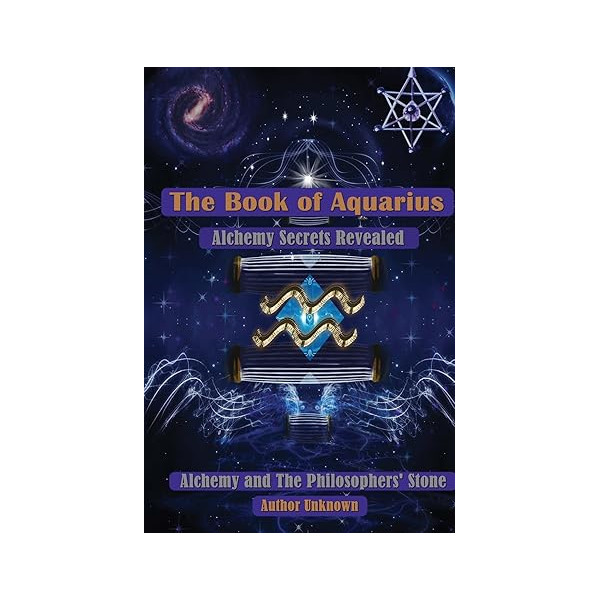
The Book of Aquarius
Alchemy Secrets Revealed
Alchemy and the Philosophers’ Stone
Author Unknown
“This is the dawning of the Age of Aquarius.”
– Aquarius/Let the Sun Shine In Lyrics by James Rado and Gerome Ragni
The Book of Aquarius – Anonymous (2011)
In 2011 a peculiar and anonymous text appeared online, announcing itself as nothing less than a manual for the creation of the Philosopher’s Stone. The work, known simply as The Book of Aquarius, quickly spread in alchemical circles, stirring fascination and skepticism in equal measure.
I was not present for its debut, though some voices in the contemporary alchemy community claim to have witnessed it firsthand. Steven School Alchemy, a YouTube creator, describes participating in a private forum where the author once engaged directly with readers. In more recent years, a broader audience has encountered the book through coverage on The Why Files channel, which featured it in a popular episode. Whether discovered through those avenues or by chance, the book remains available as a free PDF online and, for those who prefer physical texts, in print at modest cost.
The book is worth a read. It stands apart from much of the modern alchemical literature in its directness and its willingness to outline a “recipe” in plain English. Yet it is not without its flaws, and these merit careful examination.
On the Use (and Misuse) of References
I value that The Book of Aquarius cites extensively from earlier alchemical works. The author clearly intended to anchor his argument in tradition. But the way references are handled often weakens rather than strengthens the text. Normally citations serve to support a specific point. Here, quotations are sometimes tenuously related, or else delivered in such length that they obscure the argument rather than clarify it.
Some examples would be: lengthy excerpts presented with minimal commentary, quotations that repeat the same sentiment again and again without synthesis, or passages drawn from sources only tangentially connected to the claim at hand. While this approach makes the book less persuasive, it has an unintended benefit. Readers are exposed to a wide range of original alchemical voices—Sendivogius, Bacon, Bonus, Figulus, Philalethes, and many more. The Hermetic Museum, which the author recommends, is itself an invaluable collection. In this sense, the book functions as a gateway to the broader tradition, even if its argument falters.
Chapter Six: Disbelief
The most conspicuous example of over-reliance on sources is Chapter Six, “Disbelief.” Here the author attempts to address the entrenched cultural skepticism toward alchemy in general and the Philosopher’s Stone in particular. He rightly observes that in modernity alchemy has been relegated to fiction, new-age metaphor, or the territory of ridicule. The chapter compiles a cascade of quotations from older writers who made similar complaints in their own time—that critics dismiss what they cannot understand and that only practitioners have the right to judge the art.
The problem lies in execution. The chapter strings together long passages, all circling the same point, with little interpretive guidance. For those already inclined to believe, the effect is numbing rather than inspiring. For skeptics, it is unlikely to persuade. What could have been a sharp commentary on the sociology of belief in alchemy instead becomes a tedious wall of text.
The deeper irony is that many alchemical authors of old may themselves never have achieved success. Some were literary philosophers rather than practicing adepts; others may have traded on patronage while producing no transmutations. The sheer volume of writings on the Stone, once an argument for its reality, can also be read cynically as evidence of something akin to pre-modern clickbait—texts multiplying for the sake of reputation or profit rather than discovery.
The Tangents: UFOs and Shambhala
The book also contains chapters that digress into subjects tangential at best to alchemy: UFOs, Shambhala, the New World Order, planes and frequencies, even cosmological speculations about universes nested within universes. These excursions feel like the author’s personal fascinations more than integral parts of the project. They may intrigue open-minded readers, but they risk alienating those primarily seeking a manual of the Magnum Opus. For practical purposes, they can be skipped without loss.
The Method
The central question, of course, is whether the procedure outlined for producing the Stone is credible. Debate continues on forums such as r/alchemy. The method bears resemblance to what has long been called the “dry path.” The instructions are unusually direct: separate the prima materia into philosophical sulphur and mercury (not vulgar substances, but coded essences), calcine the sulphuric earth into a salt, imbibe it with the mercury, then seal and cook the compound in a proper vessel. It is a recipe strikingly clear compared to the riddling allegories of older texts.
I cannot attest to its efficacy. Practical obstacles prevent me from attempting it, and likely many readers will find themselves in the same position. Yet the clarity of description is refreshing, and the discussion of apparatus and laboratory techniques makes the work accessible to beginners.
Final Assessment
Despite its faults—the indulgence in digressions, the heavy-handed quotations, and the occasional lack of argumentative precision—The Book of Aquarius occupies a curious and valuable place in the modern literature of alchemy. It provides a map, however debatable, written in a voice that is neither cloaked in allegory nor overawed by secrecy. It is a book best read not as a final authority but as a point of departure: a stimulus for further exploration of the older masters it quotes, and an invitation to consider that the dream of the Philosopher’s Stone may not be entirely confined to the past.
If you are drawn to alchemy enough to be reading this review, it is worth downloading the free PDF or finding a copy. Whatever its shortcomings, The Book of Aquarius remains one of the rare modern works willing to say outright what countless others have implied: here is how, in theory, the Stone might be made.
Referenced Alchemical Works
The following is the complete list of historical texts cited or quoted in The Book of Aquarius. It is preserved here both for context and as a resource for further study:
- A Magnificent and Select Tract on Philosophical Water, by Anonymous
- The New Chemical Light, by Michael Sendivogius
- The New Pearl of Great Price, by Peter Bonus
- The Chemists Key, by Henry Nollius
- The Root of the World, by Roger Bacon
- The Glory of the World, Or, Table of Paradise, by Anonymous (aka Gloria Mundi)
- Man, the Best and Most Perfect of God’s Creatures, by Benedictus Figulus
- Book of the Chemical Art, by Marsilius Ficinus
- An Anonymous Treatise Concerning the Philosopher’s Stone, by Anonymous
- The Chemical Treatise, Or, The Ordinal of Alchemy, by Thomas Norton
- Aphorisms of Urbigerus, by Baro Urbigerus
- A Magnificent and Select Tract on Philosophical Water, by Anonymous
- A Brief Guide to the Celestial Ruby, by Eirenaeus Philalethes
- On The Gold Medicine and On The Yellow and The White, by Ko Hung
- Shih Hsing-lin, Disciple of Chang Po-tuan, And Hsieh Tao-kuang, Disciple of Shih Hsling-lin
- A Golden and Blessed Casket of Nature’s Marvels, by Benedictus Figulus
- The Twelve Keys, by Basilius Valentinus
- The Sophic Hydrolith, Or, Water Stone of the Wise, by Anonymous
- Fama Fraternitatis, by The Rosicrucians
- The Book of the Revelation of Hermes, by Theophrastus Paracelsus
- The Crowning of Nature, by Anonymous
- An Excellent Introduction to the Art of Alchemy, by Peter Bonus
- An Open Entrance to the Closed Palace of the King, by An Anonymous Sage and Lover of Truth
- Wu Chen P’ien, Essay on the Understanding of Truth, by Chang Po-tuan
- On The Gold Medicine and On The Yellow and The White, by Ko Hung
- The Chemists Key, by Henry Nollius
- A Golden and Blessed Casket of Nature’s Marvels, by Benedictus Figulus
- An Explanation of the Natural Philosopher’s Tincture, of Paracelsus, by Alexander von Suchten
- A Very Brief Tract Concerning the Philosophical Stone, by An Unknown German Sage
- The New Atlantis, by Francis Bacon
- Magnalia Naturae, Praecipue Quoad Usus Humanos, by Francis Bacon
- A Subtle Allegory Concerning the Secrets of Alchemy, by Michael Maier
- The Golden Tract Concerning the Stone of the Philosophers, by An Anonymous German Philosopher
- The Metamorphosis of Metals, by Eirenaeus Philalethes
- Golden Calf, by John Frederick Helvetius
- On the Philosophers’ Stone, by Anonymous
- The Golden Age Restored, by Henry Madathanas
- The Aurora of the Philosophers, by Theophrastus Paracelsus
- A Dialogue, by Alexander von Suchten
- Book of the Chemical Art, by Marsilius Ficinus,
- Verbum Dismissum, by Count Bernard Trevisan
- Compound of Compounds, by Albertus Magnus
- A Tract of Great Price Concerning the Philosophical Stone, by A German Sage
- The Emerald Tablet, by Hermes
- The Fount of Chemical Truth, by Eirenaeus Philalethes
- Three Alchemical Poems, by Chang Po-tuan
- The Epistle of Bonus of Ferrara, by Peter Bonus
- Wu Chen P’ien, Essay on the Understanding of Truth, by Chang Po-tuan
- The Secret Book of Artephius, by Artephius
- The Secret of the Immortal Liquor Called Alkahest, by Eirenaeus Philalethes
- The Mirror of Alchemy, by Roger Bacon
- The Dwellings of the Philosophers, by Fulcanelli,
- A Short Tract, or Philosophical Summary, by Nicholas Flamell
- Of the Nature of Things by Paracelsus, via Sandrovigius
Many of these books are excellent reads for understanding the concept of what the stone is in relation to nature, but none of these books dictate a recipe in the way that The Book of Aquarius does.
Regarding these books, the author of The Book of Aquarius had this to say:
“All of the quotes are from sources which are accessible to read for free online. The sources of all the alchemical books I have quoted from are these sites: sacred-texts.com, forgottenbooks.org, rexresearch.com, alchemywebsite.com.
The latter three sites include alchemical imagery on their sites or in their books, but unfortunately none of them realized the true significance of alchemy. However, all these sites and ramsdigital.com (which is not free) have done a great service to the world by publishing alchemical literature on the Internet.”